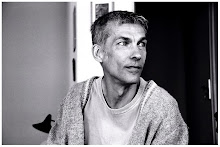
Today, October 23, 2013, is the 90th birthday of the American composer and writer Ned Rorem. I wish I could have been in New York to celebrate him, but you can't be in two places at the same time. So, my small contribution and tribute to Ned Rorem on this occasion is the article below, an article I wrote ten years ago after visiting New York and Ned a few days after his 80th birthday. The translation is my own, and it's just a draft. I hope there are not too many mistakes and/or oddities. Happy Birthday, Ned!
Whirling years
It’s one of the last days of October 2003 and I’m
walking up Broadway in pouring rain, on my way to see the composer and writer
Ned Rorem in his apartment on Upper West Side.
He’s standing in the doorway waiting for me as I get out of the elevator. He
smiles, warm and friendly, takes my hand and welcomes me. ”I have made some
tea.” There is nothing in his appearance revealing the fact that he turned 80
just three days earlier; he looks more like a youthful 65-year old. I follow
him in to a large and light living room; the walls are almost covered with art—oil
paintings, water colors and a few drawings. Behind the black Steinway grand
piano in the corner, are four pictures by Jean Cocteau. Two of them are
portraits of Rorem, the others are dedicated to him. I sit in one of the sofas.
Ned sits in the other, and he pours up the tea into blue cups and offers me a
huge and sweet chocolate cake. He almost gulps down a big piece and I think
about one fact he has often underlined in his books: ”I am just a child.” Then
he looks up and out through the window. ”I love the sound of the rain.”
Curiosity and reading
In his first book, The
Paris Diary (1966) Ned Rorem writes
free-spoken and openly about the period during which he lived in Paris. He went there in
1949 on what was supposed to be a holiday trip, but stayed until 1958. During
his stay he studied for Arthur Honegger and learned to know other composers:
Francis Poulenc, Georges Auric and Darius Milhaud. Most of the time he was
staying at the countess Marie-Laure de Noialles house in Paris, or her house in
Hyères. Marie-Laure and her husband Charles were passionate collectors of
surrealistic art. They were also tremendously rich, they supported and
sponsored artist, among them were Buñuel and Man Ray. Marie-Laure knew all the
people Rorem was hoping to meet in Paris.
She enjoyed the company of artists and gays, and Rorem was conveniently both.
He
takes yet another piece of the chocolate cake. I look at one of the portraits
of him on the wall, a small oil painting; the face of the young man seems at
the same time fragile and powerful. He often felt shy during that time, and he
often used alcohol to get over the shyness. This eventually turned him into an
alcoholic.
”Marie-Laure
painted that one”, says Rorem, who has followed my eyes.
”When were you last in Paris?” I ask.
”About
two years ago”, he replies. ”But I will never go to that place again because
there is no need to at my ripe age. I will never come to Europe
again. I’m too tired to travel. I’ve seen everything. Everything I need from France
I have already got. And the people I knew in France are all gone now. There’s no
point in trying to re-locate myself again in France. It’s a different country.
It looks the same but it’s different. I don’t have that kind of curiosity
anymore. It kind of goes with youth. I wanna see places where I know people who
are old friends.”
”Are you curious in other ways?"
”Less. If someone writes a new
opera or something, if a friend is in a play I try, out of friendship, to go
and see it, but I’m not terribly curious to see a new opera or anything, but I
end up going out quite a bit every year but much less. Less than I used too.
Maybe I should try it again, but I can’t be something I’m not.”
”What
about reading? You’ve always been reading a lot. Is that still important to
you?”
”I read all the time but I read
less than I used to. It takes me ages to go through a book and I look at lots
of magazines, and I look a lot on television—more than I like to admit—at just
junk. But on my night table I’ve got twenty books that I’m in the process of
reading. I’m curious and I buy books. I’m curious to see what friends do, but I
kind of get bored and so I don’t have as much enthusiasm about culture today…
and I think we’re going to hell. I think we’ve got about ten more years anyway.
We’re all gonna be dead. Blown up. And the mediocrity around all this is just
unbelievable. America
is still producing first rate music and plays and books, and painting too. And America
with all its coherency is probably the most interesting country in the world
today. But as I said before, nobody knows the future, so what I say about being
blown up.., well, it will or it won’t take place. But I see it’s headed towards
universal mediocrity, but maybe it’s always been that way. It’s just more
people in the world…”
Diaries
in words and tones
Ned Rorem has published some fifteen books since 1996,
most of them memoirs and diaries from a life where music, art and literature
are the main corner stones, but also love and sexuality—open and decrepit long
before Stonewall and the liberating gay movement. The openness and frankness
turned him into something of a gay icon for a large group of people. His
autobiographical writing offers an almost lifelong insight into the world and
thoughts of an artist. Rorem also writes about music—on composition, music
analysis, about musicians and composers.
His
musical works are even more comprehensive; he has written three symphonies,
four piano concertos, solo concerts for violin, percussion, flute and cello,
chamber music and solo instrument music for many instruments, and six operas;
one of them, Miss Julie (1965) is
based on the play by August Strindberg. Another, Three Sisters Who Are Not Sisters (1968) has a libretto by Gertrude
Stein.
But
most of Rorem’s compositions are songs and he is often said to be the most
prominent American art song composer. Not for nothing he has been called The American Schubert. He has written
almost five hundred songs through the years; beautiful and poetic songs with
lyrics by for example Shakespeare, Walt Whitman, Paul Goodman and Frank O’Hara.
”The only poetry I understand is the poetry I have set to music”, he states at
one time, and he continues with relating to his own: ”My music is a diary no
less compromising than my prose. A diary nevertheless differs from a musical
composition in that it depicts the moment, the writer’s present mood which,
were it inscribed an hour or so later, could emerge quite otherwise.”
Rørheim and the Norwegian origin
Ned Rorem was born in Richmond, Indiana
on 23 October, 1923.
Half a century before that his grandfather Ole Jon had emigrated from Norway.
To the new land he brought the name he had taken from the valley farm on an
island outside Stavanger
from where he came, Rørheim. But the Americans had difficulties in both
pronouncing and spelling the name and it was soon changed to Rorem.
”You
visited Norway
with your parents and your sister when you were twelve, but you haven’t been
there since. Have you any contact with relatives in Norway?”
”No, I don’t have any idea about
any relatives in Norway.
When my sister [Rosemary] got married she lived in Copenhagen for a year with her husband and
one of her six children was born there. And I went to visit her then for about
two or three days in the autumn of 1951 but that was the last I had to do with Scandinavia.”
”Is there anything Norwegian in
you? Do you have any sense of a Norwegian origin? Or is Norway just something from the
past?”
”No,
not at all. One is the sum of one’s parts and it’s how I feel about it… I feel
very much of a wasp [White Anglo-Saxon protestant], you know. A
non-Jewish. I was very attracted to Jews, they were so different to me. Some
people are attracted to their opposites which I am. Nothing could be less
Jewish than a Norwegian, at least in America. My grandfather spoke with
a da-da-da-da little singing accent, and my grandmother died long before I was
born. My grandfather lived in the Scandinavian part of United States in Wisconsin,
Iowa and my
father stressed his Norwegian background although he didn’t speak it. So yeah,
I feel that I am Norwegian in a way although I go against it. As a Quaker and a
Norwegian I was very much attracted to the Catholic Church because of the
incense, jewels, the smells and the taste and the touch and the whole falderal,
but my parents were anti-Catholic and it was… I’m anti-Catholic now, too. I
think it’s an evil religion, and as being a Quaker I’m a Quaker philosophically
rather than religiously cause I don’t believe in God. But we never talked about
God in my family. But one is the sum of one’s parts, and how those parts
collect and worked together that’s not for me to know, that’s for an outsider;
a biographer can write a bunch of stuff… ”
He
knows I’m writing an article about him for a Norwegian magazine, and suddenly
he says:
”Be
sure you mention the island Ombo. The valley of Rørheim
on Ombo. It’s not far from Stavanger.
Would it be on a map that I have?”
”I
doubt it”, I reply. ”It’s a small place.”
”Okay!
My cousin, a woman, went there ten years ago, maybe more. She went there and
she took pictures and sent them and I saw them, and it was very… ” He looks a
bit embarrassed as if not sure what word to choose. ”…beautiful.”
The
following moment he gets up to get his glasses and a large world atlas. The
well used pages are now loose inserts lying between the worn covers.
”Where…
where is Norway?” he mumbles
and Portugal and Great Britain
falls to the floor. ”This is Norway!
And Denmark.
Malmö is Sweden,
isn’t it? You know that I did an opera on Miss
Julie which is being done this coming Friday in Philadelphia, and I’m going down to see it.
Because they talk about Malmö in Miss
Julie. There’s Sweden
and here is… hm.., Kristiansand.
Is that a town? I thought Stavanger
was a lot bigger, but I can’t find it here, so… Yeah, here it is. It’s more
westerly than I’d thought.” He searches for a while in the water outside the
city. ”Yeah, you need a detailed map. I guess you can only get one over there.”
Sexuality and creativity
In Knowing when
to stop (1994) Ned tells of how he as a 14-year old boy, in the spring of
1938, started to look for love in the local parks. Under his arm that first
night, he held a copy of Anatole France’s Le lys rouge. Not because it could be a possible subject to talk
about, but because its maroon cover matched the jacket he was wearing. ”I had
almost reached the second bridge without meeting anyone, and I was about to
turn around and head back home when a figure freed himself from the darkness
and stood in front of me.”
A man—“not a boy, but an adult, a mystery, perhaps
nineteen years old or thirty”—approaches him, and moments later he has had his
sexual debut. When he gets home that night he is enclosed by the scents of that
man, and dazed by the powerful meeting. ”The following evening I looked for him
in vain, but all I found was the left behind copy of Le lys rouge among the
leaves. I kept looking for him the following weeks and months.” The man had a
deep impact on Ned. ” I've certainly been true a certain type that unshaven,
adult man in park …”
“In
the pre-concert talk the day before yesterday, you said that you started to
compose your first songs when you were 14, the same time as you were starting
to look for sexual encounters in the parks of Chicago. Is there a connection between the
creativity and the sexuality? ”
”Well,
there must be… The connection is there. You’ve already said what the connection
is, but… I think I was attracted before puberty to men, certainly as a child,
and certainly to the arts also. So, they both didn’t start then but I began
perfecting my craft by writing down music at the age of 14, and my piano
teacher helped me a little. She was black, a black woman.”
A
part from one of Rorem’s books crosses my mind; a friend of the teenaged Ned
complaints to his parents: “Why don’t we live as interesting lives as the
Rorems?” he asks, referring to the fact that Ned’s liberal parents had several
black friends and visitors at their house.
”One grows up at puberty, physically…
But I don’t think one becomes… One is always.., an artist is a child forever.
If he stops being a child he stops being an artist. Because children look at
things without blinders on the side of their eyes, and they look at the whole
world. Rilke began one of his elegies ’With all eyes, the creature sees the
open.’ [The first stanza of the eight elegies: Mit allen Augen sieht die Kreatur das Offene.] And he’s always ahead of him …. But when the artist starts to grow up he
starts losing what being an artist is. And then there’s artists who never has
any sex at all, but they think about it—I can’t prove it but I just know
myself…”
“Many of the poems you have set to
music were written by homosexual poets and authors, and your own sexuality—and therefore
also your own sexual preferences—gets plenty of room in your books. Is the gay
aspect important for your creativity?”
”I
don’t know. I am what I am. I am the combination of various things that play
upon each other, but I have a lot to say about how they do that because I am me
and you are you, and there’s other people who are the same, who are gay and in
my age… For example, people say if we could only clone Mozart—it’s always
Mozart as if he were the only great man that had ever lived—and I say, if we
could clone Mozart and suddenly Mozart was sitting in this room cloned, this
new Mozart might not be interested in music at all except rock ’n’ roll. He
might not like Mozart. Environment is everything and how you’re raised and so
forth. And as for what gay music is no-one can define that. And even gay
literature, you can’t define that because it doesn’t necessarily have to do
with subject matter, as a way of approaching subject matter, I suppose, but
music can’t be proved to have any meaning at all.”
He
pauses for a moment before he continues.
”I
like to be dominated in sex, but in the parlor I like to dominate. So I want
everyone to listen to me and shut up, or I’m the husband in the parlor and the
wife in bed. Or in French, Le bourou au
salon et la victim au lit. And I think many artists are split down the
middle sexually in that way, or if they are very sexually dominating they
are.., somehow they are not artists. But then, the sooner you make a role about
an artist, the caring feeling of an artist, then along comes another artist
who’s equally great and doesn’t fit the bill at all.” He sips his tea and puts
down the cup. ”I don’t think that gayness is an interesting subject unless it’s
political. It’s just as boring as heterosexuality.”
“But
what about sexuality in general? I mean, no matter what your personal
preferences may be.”
”I
don’t know if sex is meaningful but I think about it all the time, but I don’t
do it nearly as much as I would like to. And … I said some place recently…
everybody wants sex and love but even stronger than that is appreciation. And I
think appreciation is necessary too.”
”Do
you get the appreciation you want?”
”I’m
getting a certain amount of appreciation on my 80th birthday, and
I’d rather be appreciated than being not appreciated, even though I’m sort of
depressed most of the time.”
Ned’s
latest book Lies (2000) consists of
diaries from the years 1986-99, and partly the book is very sorrowful. Not only
does it describe the painful course of the disease and the death of Ned’s life
companion James Holmes, it is also a shocking testimony from someone who had
his main social intercourse with homosexual men; each and everyday some friend
or someone close has been diagnosed HIV-positive or developed AIDS. Or someone
has died. At one time Rorem refers to his address book as a cemetery.
Loneliness and simplicity
”Recently in an article you said, ’The older I get,
the aloner I get’, and in one of your diaries from the 70’s, you wrote, ’The
older I get, the simpler I get’. Is there a connection between this
increasingly evident loneliness and the more and more obvious simplicity?”
”I
suppose, but that’s not for me to say, that’s for you to say. We all die alone,
and by extension we all live alone, really. I’m always accused for being
narcissist, but everybody’s a narcissist, everybody thinks of himself
constantly, and everything”, he makes a gesture towards large window behind me,
”the rain relates to me, this relates to me, you relate to me, everything is
from my stand-point. The same goes for you. But then you die alone. Gide wrote
in his book La Porte étroite, ’Strait is the gate to which we enter the next world, and
it’s too strait for two people to walk side by side’. I think the older I get
the simpler I get in my work, certainly. I’ve always tried to rid my work of
everything extraneous.”
He
stops and turns to me, asks me about a young man who was my lover and friend
years ago. ”You had a friend who died. And he died of AIDS?” He asks me further
questions about Thomas. Ned—who not only lost his lifetime companion James
Holmes but also many other friends and dear ones—leans forward and listens to
me; his face is very naked, touching, and the, according to many people,
narcissist is long gone; he is listening to someone else, someone else’s story
is touching him deeply. ”It’s terrible. All death is terrible and there is
never a right time to die, even for old people. The more you know them, the
less you think they ever going to die. Your parents, your grandparents… But
they do. We’re all gonna die… ”
Again
he’s silent. He looks out of the window. The rain has stopped, and it’s getting
darker.
The Sorrow behind the words
Before we go to this night’s concert at Merkin Hall we
have a little supper in Ned’s kitchen. We sit around a table covered with
books, letters, papers and photographs. Ned’s niece Mary Marshall is there;
she’s helping him with all practical arrangements concerning his birthday.
Ned’s neighbor and friend Barbara Grecki is also there. We talk about Scandinavia,
about Norway and Denmark.
I look around in the dining-room; here too, the walls are almost covered with
art and books. Beside the small window towards the backyard there is yet
another portrait in oil by Marie-Laure. The motif is once again the young
Rorem. The elder and more lively Rorem is sitting in the kitchen sofa beside
me. Behind him there’s a big painting by Gloria Vanderbilt. A dotted cat.
The
conversation glides over to literature and someone mentions Carson McCullers.
Ned suddenly seems distracted, and when Barbara and Mary leaves the table, he
reaches out for a thick paperback, Virgina Spencer Carr’s biography on Carson
McCullers.
“I
had a relationship once with Carson’s
brother-in-law [Tommy McCullers]. Perhaps there’s a picture of him here somewhere.”
All of a sudden something sad has a grip on him, but I don’t understand what it
is. “No, there’s no picture of him here, He killed himself. Perhaps it was my
fault. Perhaps he did it because of me. But no, it can’t be anyone else’s
fault. You always have a choice”, he says without sounding too convinced. And
once again I sense that sadness that so often hides behind the precise and
brilliant wording in Rorem’s books.
Even the trees
A few days later we meet again. The calendar states
it’ll soon be November, but it’s sunny and warm like in the beginning of
September. Perhaps that’s why we start to talk about Ned’s summer house in Nantucket.
”I
spend about a third of the time there. I’ve never own anything in my life, but
I bought a house there in 19… well, about thirty years ago with my late friend
Jim Holmes. It’s a nice enough house, and the heat’s on all the time so that I
can go whenever I want. It’s an ordinary house, but my friend Jim Holmes who’s
been dead now for about four years fixed it up…”
James
Holmes was Rorem’s junior by sixteen years. They met in the mid 1960’s, and
lived together in a mostly un-sexual relationship for thirty-two years, until
James died in January 1999. “What I feel for [James] is deeper than love”,
Rorem writes in Lies. Holmes was an
organist and a choral leader, but he was also a composer. Rorem often mentions
his beautiful Stabat Mater for choir
a capella.
Six
months after his lifetime partner had passed away, Rorem received a cassette
from a choir leader in some church. There’s a composition by Rorem on the tape,
and he dutifully sits down to listen to it. But as soon as the music begins he
breaks down in tears—“not because I was listening to my own music, but because
I was listening with Jim’s ears ... Is he still in the room? Can he read this?”
”When
Jim was around we had one dog and several cats, but I don’t want that anymore.
It’s a big responsibility.”
”
Are you interested in nature?”
”In
what sense?”
”Do
you long for the nature? When you go to Nantucket,
do you walk along the beach or in the forest?”
”There’s
not many forests, and I don’t go to the beach as often as I should. Last year I
don’t think I swam but once although it’s very good for you. Yes, I love
nature. And I’m always impressed of how nature doesn’t care one way or another
about us. The trees… I have three beautiful trees on my property, and there
they are whether I’m there or not. There just huge things looking… Arthur
Miller ended one of his books, his autobiography it was… He had bought a new
house in the country. At night when they turned the lights on there were wolves
and jackals 800 feet away looking at him and then Arthur Miller said, ’I think
that all the animals—the world and even nature into the axe—looks at us. Even
the trees’. Those three words were the last words; even the trees. And I
thought of calling my next book Even the
trees. It’s a very pretty title. And I look at the trees as though they
have some sort of consciousness. And I don’t
know why they wouldn’t. They’re growing continually and their green is
growing… So yeah, I guess I like nature. But it can be very lonely.”
Forget-me-not
He tells me something about one of last weeks
concerts, and I ask him what it like is to hear your own music being performed.
”I listen to it as if someone else made it. Sometimes I admire it, sometimes I
don’t. And in fact, another person did write it. It’s me in another time.”
”Your
cello concerto had it’s European premiere recently. Have you heard any
performance of it?”
”I’ve
only heard it on a bad tape that was sent to me. But the cellist who’s name is
David Geringas—I think he’s from Lithuania—played
it about a week ago in Munich,
and he sent me a note. I’d like to hear a good performance of it live. I know
it wasn’t recorded in a professional way, but it was probably recorded and I’d
like to hear that.”
”At
the Miller Theater you said, that you don’t really like he organ, and not the
guitar and definitely not the percussion. But I get the impression that you do
like the cello. You’ve written quite a few pieces for cello, haven’t you?”
”It’s
probably because.., well, I’ve written for everything. I’ve written lot of
violin music, a little viola music and cello music, double-bass music. But when
I started being professional, writing music, background music for plays—nobody
does it anymore but a lot of it was done in the 40’s and 50’s. All the
Tennessee William’s plays had background music by me and by others—the only
instrumentalist I knew, and that was from school, was a cellist named Seymour
Barab. So I would write for him in mind. It was a very practical thing. Just as
later I wrote for a mezzo soprano named Nell Tangeman. So I knew kind of what
the cello could do and still do. I didn’t write solo violin music until ten
years later, I suppose. But I feel comfortable with the cello, although I can’t
play it at all. I can’t play anything at all except the piano.”
“How
much do you compose nowadays?”
"There’s
something going on in my head even when I’m talking to you, I suppose.
Composers are never not composing,
like writers are always writing in some way. How can I use this? How can I do
this and that?”
”Do
you ever surprise yourself when composing?”
”I
don’t know quite what that means. And I don’t even know quite how I compose. I
use the piano much less than I used to, so I don’t sit at the piano looking
around for any old notes. I can sometimes work out certain harmonies together,
but mostly it’s in my head.” He pauses for a while. ”All music is a song
expression, whether it’s for voice or not. There’s always a singer inside of
the composer trying to get out.”
”You
have also written music for one film…”
”But
it was cut. The movie was called Panic in
Needle Park [Directed by Jerry Schatzberg, 1971.] and they ended up not using any music, I’m glad to
say. It was better without music. But there was one long scene without any
words, and I wrote a set…”
“But
you used parts of it in another piece, didn’t you?”
”I
did, yes. In Air Music . Ten
variations for orchestra.”
For
the orchestral piece Air Music (1974)
the composer was awarded the Pulitzer prize in 1976.
”Several
times you have said, that when you’re gone you will be remembered only for the
Pulitzer prize. Do you really think that is how it will be?”
”I
don’t know what I will be remembered by, but I want to be remembered. It’s very
important to me. Very. I know people who say it’s not to them but it is to me, ‘cause
I don’t see any reason for being alive. I don’t think life has any meaning, but
human beings are complicated and we give meaning where there isn’t any meaning,
because we’re human beings. And art is a way of killing time ‘til time kills
us. Mostly though, people try to make money to give meaning to life. I would
like my work to outlive me and be around in ten or ten thousand years. Maybe it
will, maybe it won’t. But posterity is important to me.”
”So
you make your own meaning in life?”
”We
invented religion, we invented God. We invented heaven... and even then, I
don’t say there is no life after death or no consciousness after death—maybe
there is—but if there is it would have to do not with God or anything, but with
the physicality of the universe.”
I
think about one of the finishing lines in his The Paris Diary: ”If, after dying, I discover there is no Life
After Death, will I be furious?”
Ned
looks into my eyes once again.
”There
is no meaning to life. I give it meaning.”
Then
he gets up from the coach. ”Now I’m very tired. I will have to take a nap.” He
looks at his wrist watch, and says I can stay in the apartment while he sleeps,
if I want to. ”You can read or do whatever you want for an hour or so. We’ll
have something to eat and then we’ll go to Merkin Hall for the concert. Would
you like that?”
The years are whirling by
Our first meeting was at the Miller Theater at Columbia University one week earlier during a
performance of Rorem’s magnus opus
when it comes to vocal compositions; Evidence
of Things Not Seen—a cycle of 36 songs based on lyrics by for example
Goodman, Whitman, Stephen Crane and Theodore Roethke. The piece covers all
aspects of life; the beautiful melodies, sometimes painfully beautiful, have
lyrics to which you easily can relate—birth, growing up, love, war and
sickness, death and sorrow. Some of the musical themes appear are repeated;
they underline a certain emotion, and holds everything together.
Our
third and last meeting before it’s time for me to go home, take place at a
chamber music concert at Weill Recital Hall at Carnegie Hall. Rorem is
listening, very concentrated, to a performance of his second string quartet
from 1950. When the last tone of the finishing lento part has faded out, he is
very touched and filled with emotions; he claps his hand for a long time. Then
he leans closer to me: ”It’s so strange to hear that music now. I haven’t heard
it for fifty years.”
And
I leave the States and return to Stockholm.
Only days later I receive a letter from Ned Rorem. ”Come back soon and see us.
The years are whirling by.”
Håkan Lindquist, December 9, 2003.